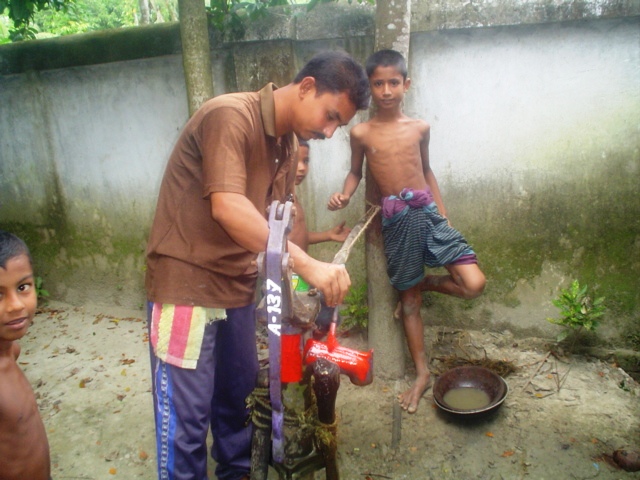
Access to safe drinking water is a big concern in Bangladesh when we consider groundwater arsenic contamination. In terms of population exposed, it is the most serious problem in the world. The need for providing arsenic safe water becomes the highest priority. Since its detection in 1993, it has been found out that about 30% tube wells, mostly from the deltaic and flood-plain area, are containing arsenic over permissible limit (50ppb) for drinking water of Bangladesh. So far, about 38,000 arsenicosis patients have been identified.
The 9 most important issues for arsenic mitigation are to:
- conduct awareness activities,
- carry out water quality test,
- create alternative safe water devices,
- manage and rehabilitate arsenicosis patients,
- create manpower to provide services for safe water supply through trainings,
- help individuals and organizations in developing safe water points through consultancy,
- build up the capacity of the beneficiaries, local resource persons, arsenic mitigation committee, local government institutions, line departments, etc
- coordinate with the GOs, NGOs and related bodies who are working for the same targets, and
- make networking with the institutions/organizations, individuals, etc who are working in the same field.
Though in the past, many mitigation activities have been done by various stakeholders, still the general information about the consequences of drinking arsenic contaminated water did not permeate among the communities properly, and the access to safe drinking water is minimal. Many safe water points created in the past are now inactive because of technical glitches and poor maintenance. Proper infrastructure and capacity building of beneficiaries and support groups still needs high attention. Water quality testing facilities did not reach the doorsteps of the people evenly. Strong basis for developing an appropriate surveillance system for patient management is still lacking comprehensive efforts. Rehabilitation of arsenicosis patients is mostly unheard and unattended. Coordination and networking with different related government institutions and development organizations is also a serious issue for arsenic mitigation.